Lockwood de Forest brought Indian carving to a Californian street
A designer who spent years studying woodcraft in Ahmedabad gave Santa Barbara interiors that nobody could have predicted from the street.
How a New York designer ended up in Ahmedabad
Lockwood de Forest was not primarily a Californian. He was born in New York in 1850, trained as a landscape painter, and travelled widely before gravitating toward the decorative arts in his thirties. The pivot came partly through his friendship with Louis Comfort Tiffany, with whom he collaborated on high-end interior commissions in the 1880s as one of the founding partners of Associated Artists. But de Forest's real obsession was with the carved teak and woodwork he had encountered in Gujarat, and particularly in Ahmedabad, on an extended visit to India in 1881.
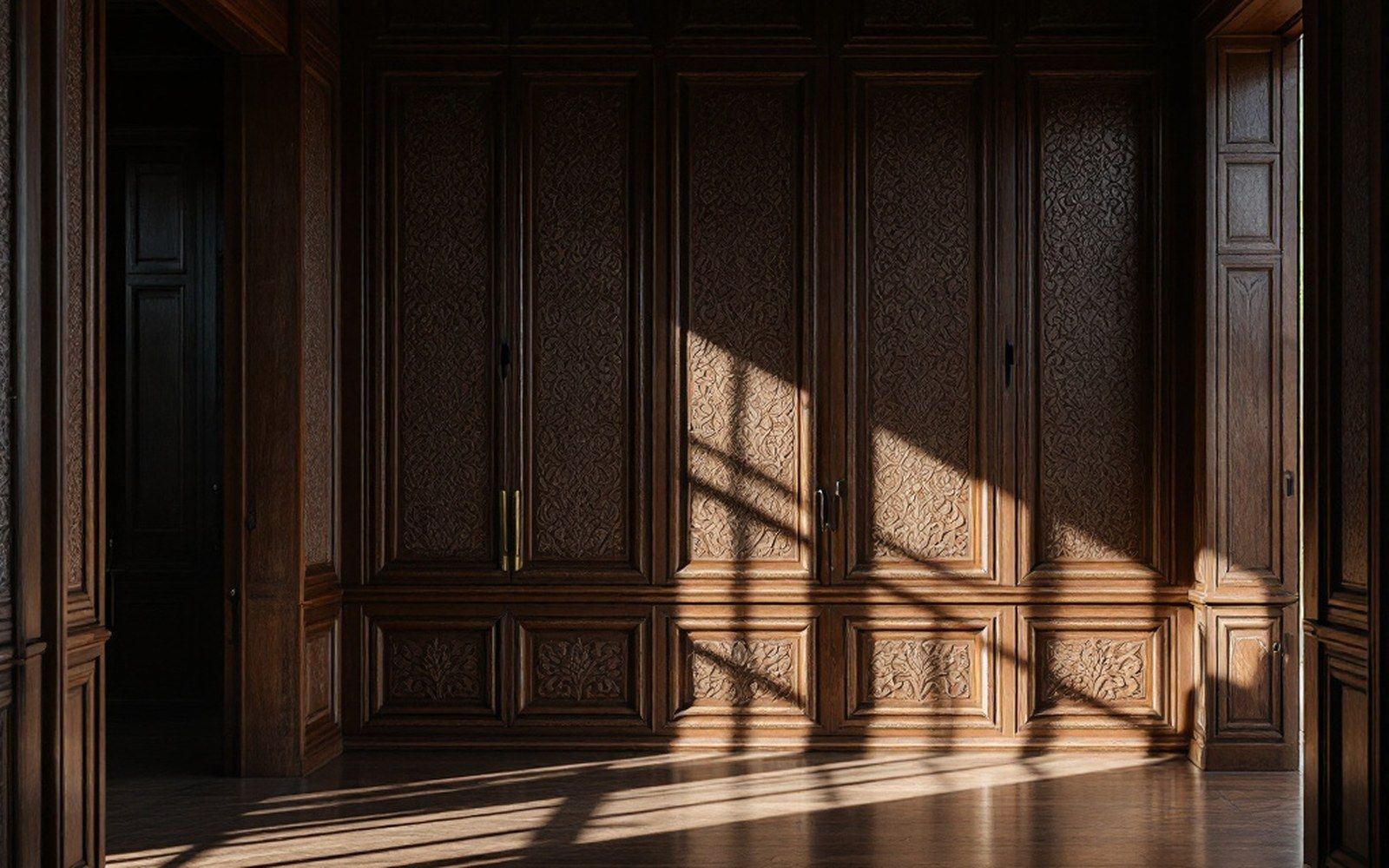
What he found there was a living tradition of relief carving — dense, geometric, endlessly repeated — applied to building facades, screens, brackets and doors. He did not simply collect examples. He established a workshop in Ahmedabad, employed local craftsmen, and arranged for the work to be shipped to the United States, where he incorporated it into architectural interiors and decorative objects for wealthy clients. The arrangement ran for years: carved panels and architectural elements produced in India, finished and fitted into American rooms. Associated Artists, the short-lived firm de Forest co-founded, is documented as one of the period's most significant attempts to bring craft reform into domestic interiors.
What arrived in Santa Barbara
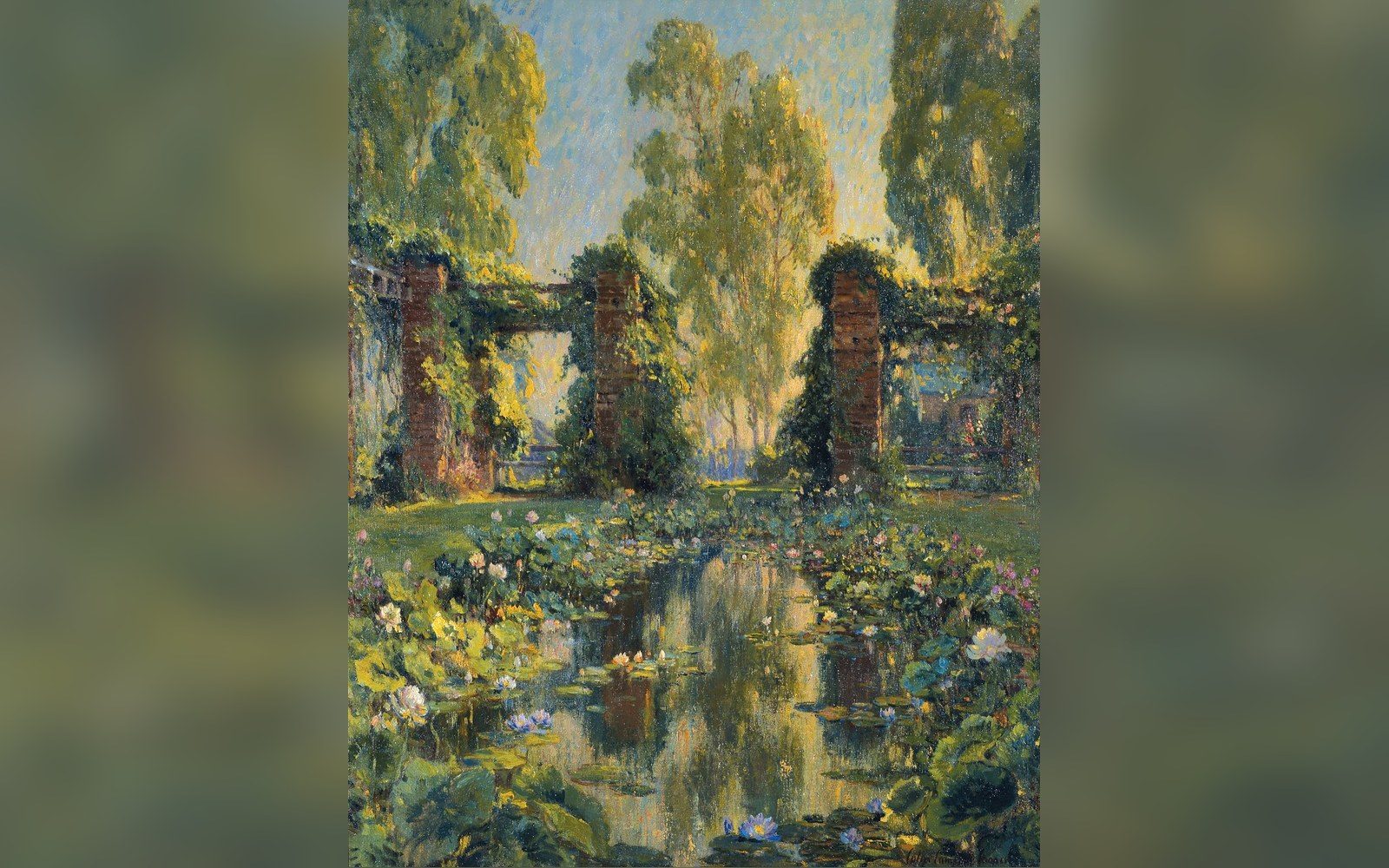
De Forest moved to Santa Barbara in 1898 and lived there until his death in 1932. The city was then a prosperous resort town with a small but serious arts community — Thomas Moran and Colin Campbell Cooper both worked on this coast — and de Forest fitted comfortably into that culture of resident artists who took the place seriously as more than a backdrop.
What he brought with him, physically, was inventory: carved teak screens, brackets, friezes and panels produced in the Ahmedabad workshop. He built these into the houses he worked on in Santa Barbara, inserting Indian carving into Californian rooms in ways that made the interiors look nothing like the Spanish Colonial Revival facades they sat behind. The discontinuity was the point. De Forest believed that good craft was good craft regardless of origin, and that a Californian interior had no obligation to match its exterior's historical references.
His own studio-home in Santa Barbara became the fullest expression of this thinking. Inside, the teak carving from Gujarat sat alongside American Arts and Crafts furniture and paintings. The effect was layered and specific in a way that generic period interiors were not — an argument made in wood grain rather than in print.
- 1850Lockwood de Forest born in New York
- 1881Extended visit to Ahmedabad; workshop established with local craftsmen
- 1880sAssociated Artists partnership with Louis Comfort Tiffany; New York interior commissions
- 1898De Forest moves permanently to Santa Barbara
- 1932De Forest dies in Santa Barbara
The craft argument underneath the ornament
De Forest was working at the same moment as William Morris and the broader Arts and Crafts movement in Britain and America, and he shared their conviction that industrial production had severed the connection between maker and object. The Ahmedabad workshop was his answer: keep the craftsmen, keep the technique, export the result. It was also, inevitably, a colonial-era transaction — an American designer commissioning South Asian labour for a Western market — and that dimension is part of the historical record, not a footnote to it.
The Metropolitan Museum of Art holds examples of de Forest's decorated furniture and panels, which give a precise sense of the density and quality of the Ahmedabad carving as it appeared in finished American contexts. The scale of his Santa Barbara work is smaller and more domestic, but the same grammar of carving appears: deep undercutting, repeated vegetal forms, borders that frame and subdivide a surface without ever quite resolving into symmetry.
What this means on the ground in Santa Barbara is that a handful of interiors carry an aesthetic genealogy that runs through Gujarat before it reaches California. The outside of the building speaks Spanish Colonial Revival; the inside speaks something older and from further away. De Forest spent thirty-odd years in the city, enough time for the work to embed itself. It is there in the grain of the woodwork, for anyone who knows to look.