Thirteen seconds in June, and a town that came back different
The June 1925 earthquake flattened much of State Street. What replaced it was decided by a review board rather than by the owners.
The morning State Street fell
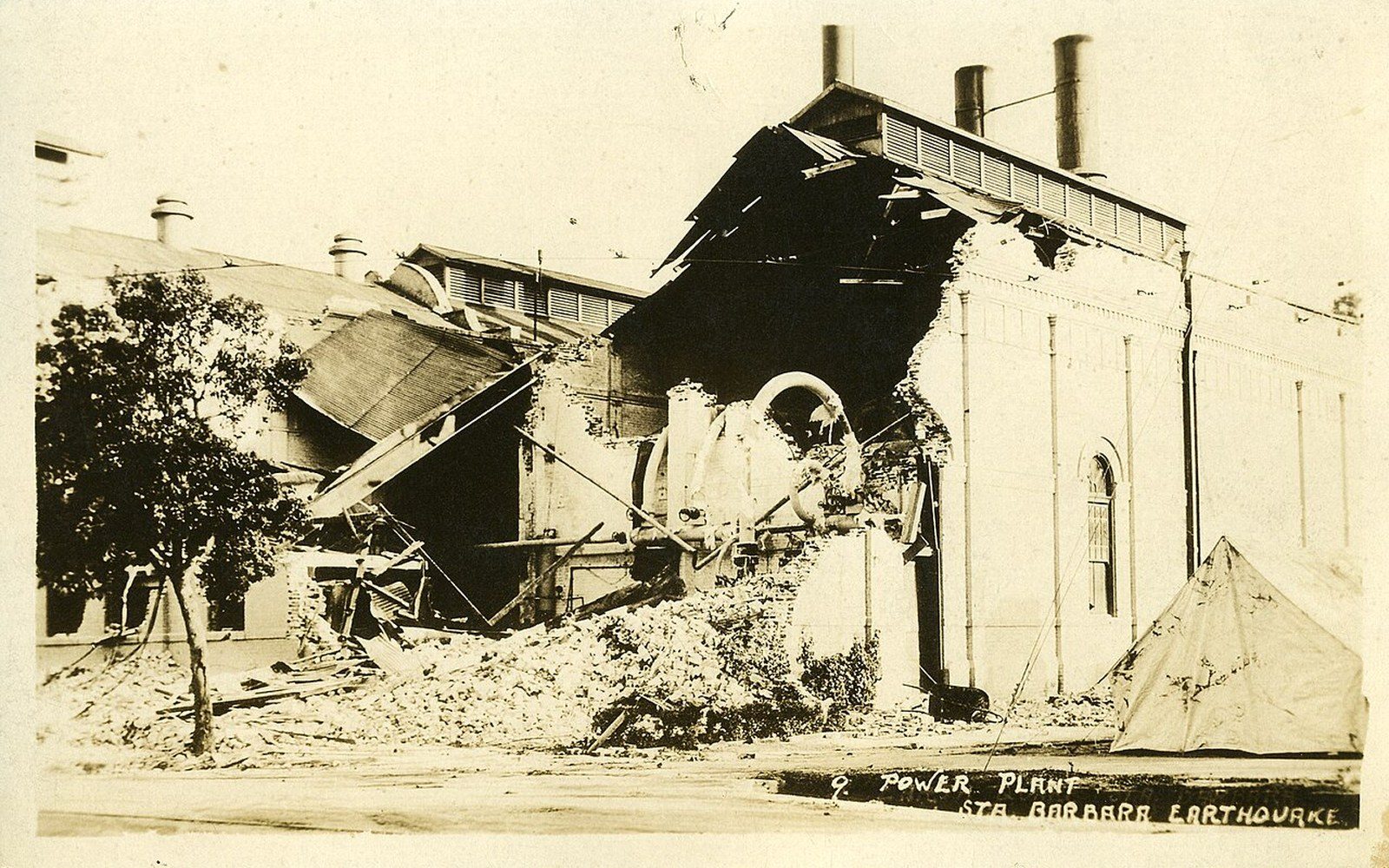
At 6:42 on the morning of 29 June 1925, a magnitude-6.8 earthquake struck beneath the Santa Barbara Channel. The shaking lasted perhaps thirteen seconds. By the time it stopped, the commercial heart of the city was rubble: chimneys down, facades collapsed onto the pavement, the unreinforced brick buildings that lined State Street reduced to a problem that would take years to solve. Thirteen people died. The financial damage ran to roughly eight million dollars at 1925 values — a sum that would have justified rebuilding fast, cheap and plain.
What happened instead was neither fast nor plain. Within weeks of the disaster, the city had reconstituted a body that would shape every building going up on the ruins: the Architectural Board of Review, a design oversight committee that had existed in skeletal form since 1923 but had never had real work to do. Now it had nothing but work. And it had a strong opinion about what a rebuilt Santa Barbara should look like.
The board pushed, consistently and with considerable force, for Spanish Colonial Revival — a style that drew on the missions, the colonial-era adobes and the broader Mediterranean tradition that California's early boosters had been selling since the 1880s. The argument was partly aesthetic and partly economic: a coherent architectural identity, the thinking went, would attract the kind of prosperous, cultivated visitor and resident that the city wanted. It was, in effect, a civic brand imposed through architectural review, and it worked with a thoroughness that surprises people encountering it for the first time.
- Spanish Colonial Revival
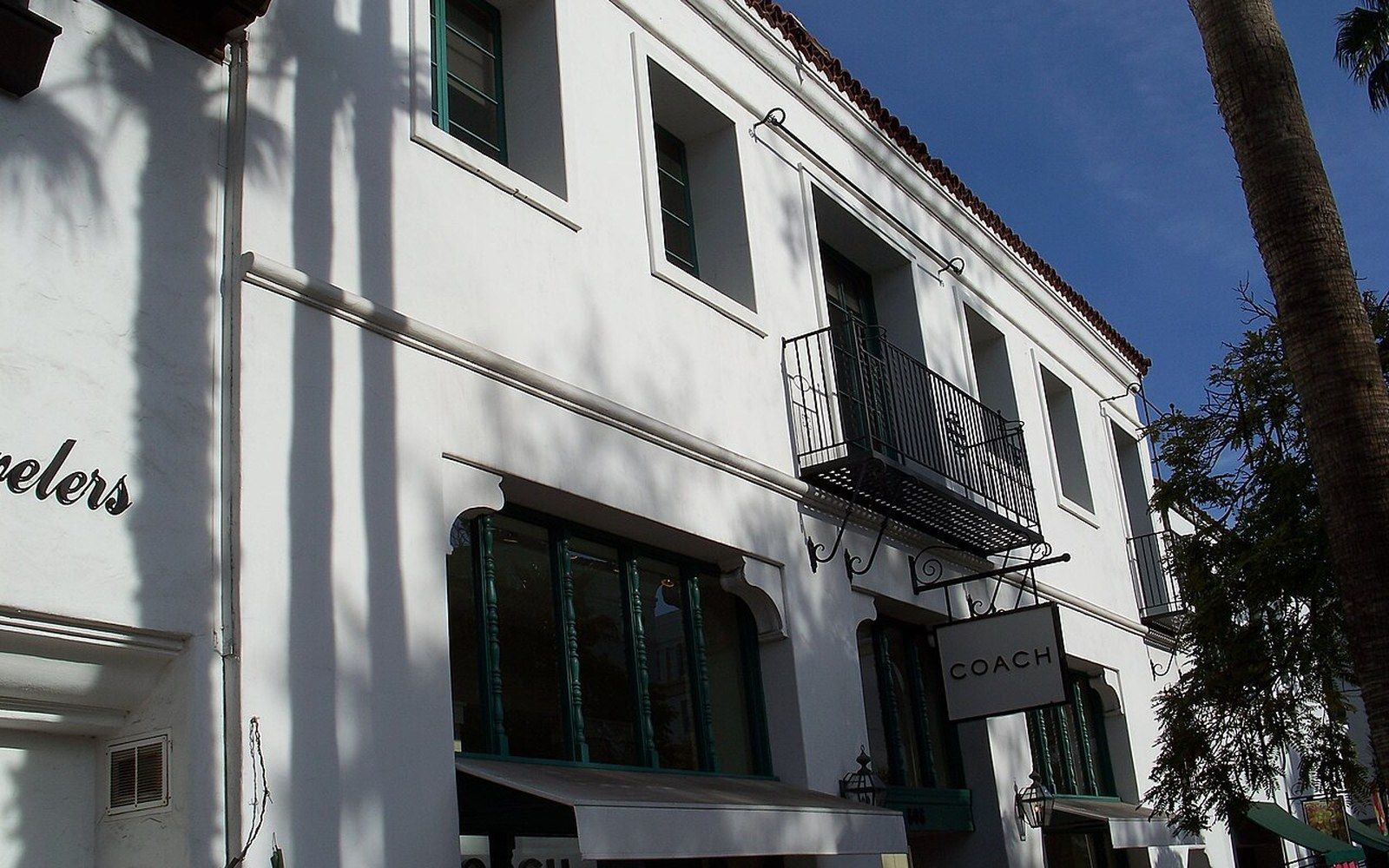
- whitewashed stucco, red-tile roofs, arched openings, wrought-iron detail; the style the board made effectively compulsory after 1925
- loggia
- covered exterior gallery, open on one side; a recurring feature of the idiom
- kunsthalle
- non-collecting exhibition space existing purely to show contemporary work; what the Contemporary Arts Forum was
- adobe
- sun-dried earth brick; the building material of the original colonial-era structures the Revival style referenced
What the style required and what it produced
Spanish Colonial Revival is not a simple formula, but its signature features are consistent: whitewashed or cream stucco walls, low-pitched red-tile roofs, arched openings, wrought-iron detailing and the occasional loggia — a covered exterior gallery, open on one side — that borrows directly from the cloistered courtyards of the Iberian peninsula. The style had been popularised at the 1915 Panama-California Exposition in San Diego, where Bertram Goodhue designed the exposition buildings in a manner that made the idiom feel simultaneously ancient and sunny. Santa Barbara's board adopted it not as a suggestion but as a condition of approval.
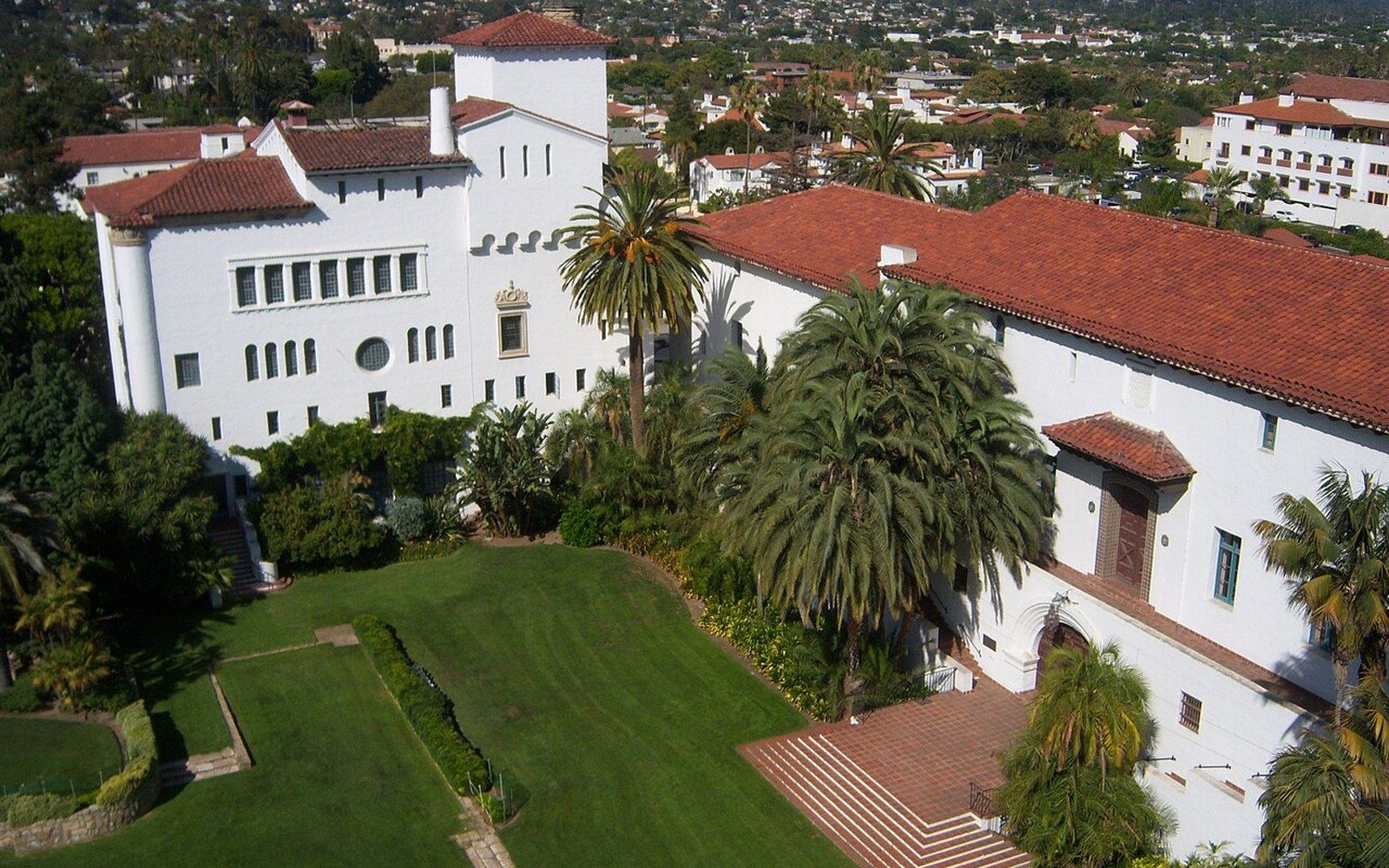
The results are still visible the length of State Street and into the side streets off it. El Paseo, a shopping arcade built into the block just east of State Street in 1922 — before the earthquake, as it happens — gave the model its local proof of concept: a warren of covered passages, tiled fountains and small courtyards that felt genuinely Spanish without being a theme park. After 1925 it served as a reference point for what the board wanted everywhere else. The Santa Barbara County Courthouse, completed in 1929 and now widely regarded as one of the finest public buildings in California, showed how far the idiom could be pushed: its sunken garden, its mural room, its open tower with views over the red rooftops below are Spanish Colonial Revival operating at the scale of civic ambition rather than commercial necessity.
The board's authority was not absolute — owners could and did push back — but its capacity to delay approval gave it real leverage. Architects who worked repeatedly in Santa Barbara learned the vocabulary quickly. Those who arrived expecting to do something else often found themselves working within it anyway. The style became, over decades, so identified with the city that departures from it read not as modernity but as failure of nerve or taste. That is a remarkable outcome for what began as emergency planning in the summer of 1925.
- 29 June 1925magnitude-6.8 earthquake strikes beneath the Santa Barbara Channel; State Street largely destroyed
- 1922El Paseo arcade built, pre-earthquake; becomes post-earthquake model for the style
- 1923Architectural Board of Review established in early form
- 1925 (post-earthquake)Board reconstituted with effective authority over rebuilding
- 1929Santa Barbara County Courthouse completed
- 1941Santa Barbara Museum of Art opens on State Street
- 1990Paseo Nuevo shopping centre opens; Contemporary Arts Forum moves in
- 2013Contemporary Arts Forum closes; programme later continues as MCASB
The art life that grew inside the architecture
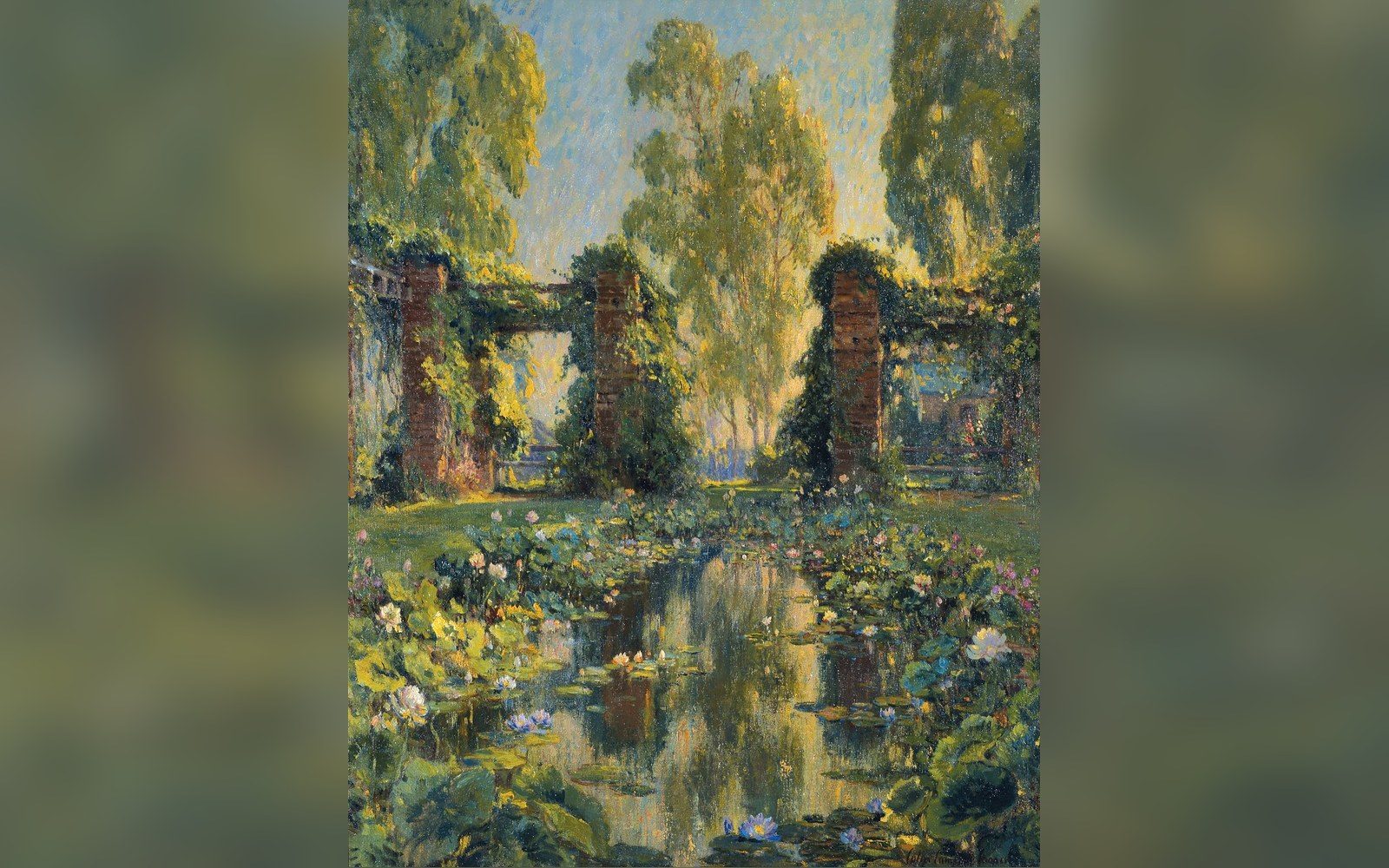
A consistent built environment does something to the art that happens inside it. Santa Barbara's Spanish Colonial Revival streetscape attracted painters before the earthquake — plein-air painters drawn to the particular quality of the coastal light — and continued to attract them after. The architecture gave the city a legibility, a sense that it knew what it was, that made it easier for galleries and institutions to plant themselves without fighting the context.
The Santa Barbara Museum of Art, which opened on State Street in 1941 in a former post office, benefited from exactly this stability. The building's neoclassical bones were dressed, over time, to sit more comfortably in their surroundings; the museum became one of the anchors of a street that had been rebuilt, on the board's terms, into something coherent enough to hold institutions.
Decades later, the Contemporary Arts Forum made a different kind of argument about architecture and art. When it moved into Paseo Nuevo — the shopping centre that opened on State Street in 1990 — it was occupying space inside a building that was itself a product of the board's oversight, built to Spanish Colonial Revival guidelines like everything else on that block. A non-collecting kunsthalle (an exhibition space that owns no permanent collection and exists purely to show work) sitting above the retail floor of a mall: the irony was deliberate and productive. The forum ran there until 2013, when it closed and its programme was eventually carried forward by MCASB, the Museum of Contemporary Art Santa Barbara.
What the earthquake set in motion, in other words, was not just a building campaign but a long argument about what a small city owes its own appearanc
What the earthquake set in motion, in other words, was not just a building campaign but a long argument about what a small city owes its own appearance — and, by extension, what appearance owes the life that happens inside it. The board's formal authority to review designs has been continuous since the 1920s, and its decisions are a matter of public record. The 1925 earthquake itself is documented in the USGS historical earthquake archive as the event that remade a city's face in thirteen seconds and set the terms for everything that followed.
That is not a common outcome for a disaster. Most cities rebuild as fast as money allows and end up with the streetscape that convenience and the market produce. Santa Barbara rebuilt slowly, on a committee's terms, and ended up with something that looks like a decision rather than an accident. Whether that decision was wise depends on what you think cities are for. The art life that has persisted here — the museums, the forum, the painters still working the coastal light — suggests that a city with a strong opinion about its own face is not, in the end, a bad place to make things.